
Case Study
Hippo Multipower
Find out more about the development of Hippo’s range of Hybrid Diesel Electric Vehicles; the optionally (un)crewed HAWC and the fully uncrewed RAPTOR
THE SOLUTION
Hippo Multipower
The journey began at the Army Warfighting Experiment in 2017 with a diesel hydraulic ATV. Pardus Defence & Security assisted Hippo Multipower to deliver optionally crewed ATVs for the British Army’s Robotic Platoon Project in 2020.
In 2021, with support from Pardus Defence & Security, Hippo released a family of hybrid diesel electric ATVs, available in crewed, optionally crewed and fully uncrewed variants. The optionally crewed “HAWC” was purchased by the Ministry of Defence under a “buy and try” and the fully uncrewed “RAPTOR” has been used by DSTL for digital crew and wider teaming assessments.
To find out more about the HAWC and RAPTOR and Hippo Multipower’s wider portfolio of military power solutions including multipower (electric, pneumatic, hydraulic and welding) generators and exportable power upgrades for the Polaris MRZR family, see below.
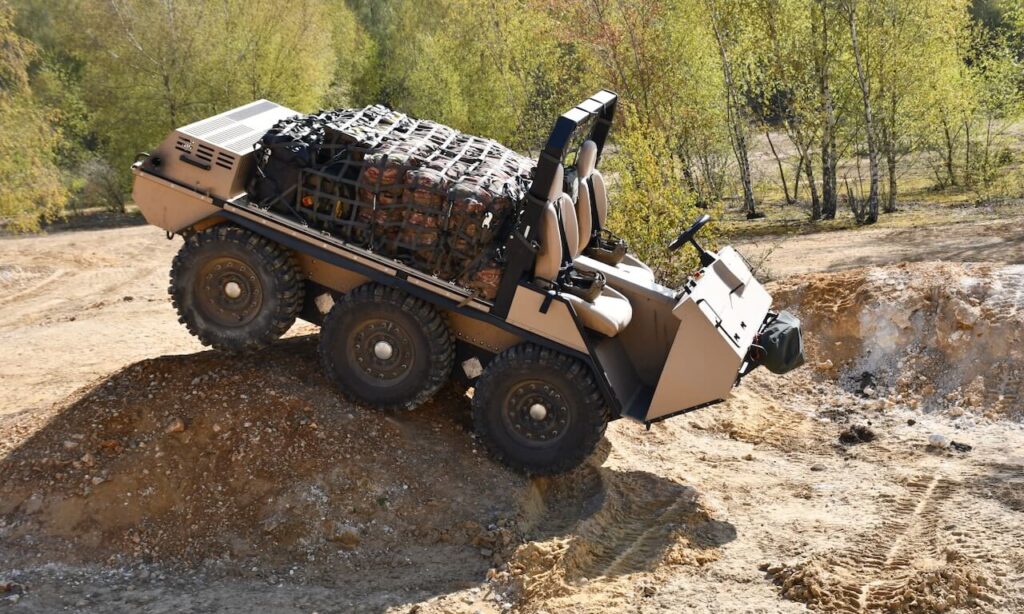

The HIPPO HAWC addresses the challenges for light forces in four ways:
- Load carriage
- Mobility
- Power generation
- Optional robotics
THE SOLUTION
The Hippo Hybrid All Terrain Wheeled Carrier (HAWC)
HAWC and RAPTOR have a payload of 1000 kg. They can be rapidly reconfigured with different payloads including
Mobility

The HIPPO HAWC and RAPTOR can be rapidly deployed by air and aviation assets. They are air droppable by parachute and can be internally transported by support helicopter such as CH-47 or underslung by utility helicopters eg UH-60.
The electric drive motors give the HAWC and RAPTOR massive amounts of torque and rapid acceleration. The all wheel drive and skid steer provide the HAWC and RAPTOR with excellent terrain accessibility in the most demanding conditions including sand, snow, swamp, jungle, forest and mountain terrain.
When operating on battery power, the HAWC and RAPTOR have extremely low thermal and acoustic signature. An integrated diesel generator provides the vehicles with range and endurance.
Exportable Power

Robotics & Autonomous Applications
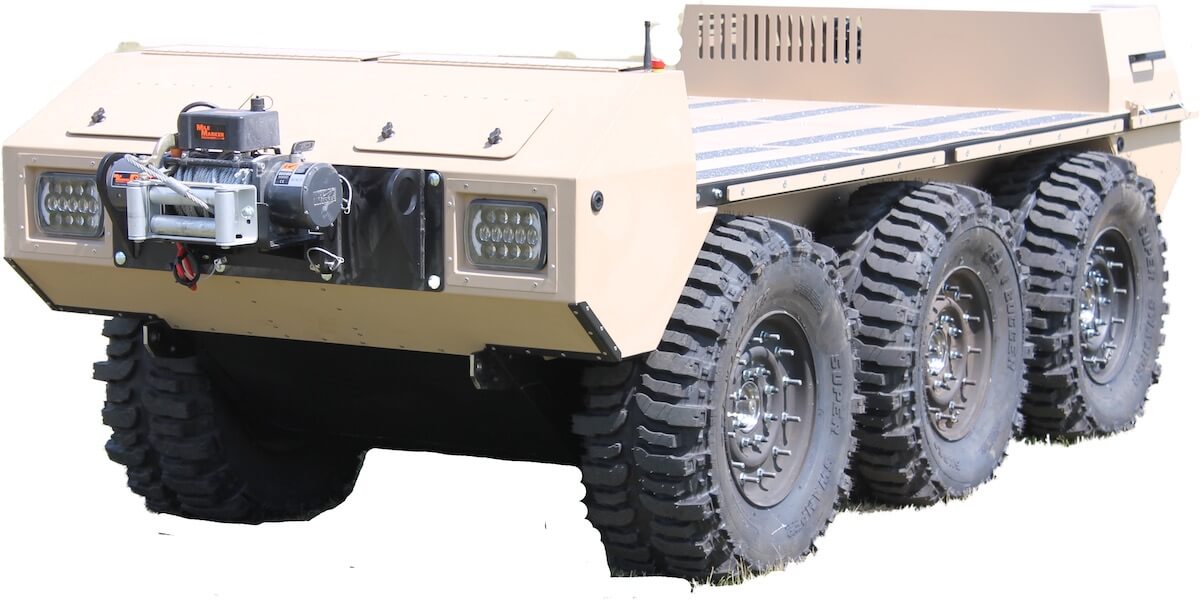
HIPPO has a proven track record in supplying autonomous vehicles. The previous “ATSV” platform was supplied to the British Army as part of the Robotic Platoon Vehicle (RPV) Spiral 1 as well as the Autonomous Last Mile Resupply (ALMR) project.
All HIPPO HAWC platforms are “drive by wire” allowing a robotic applique kit to be fitted. The level of autonomy can be defined by the customer; ranging from line of sight remote control to “follow me,” waypoint navigation, route selection, GNSS denied navigation and obstacle detect obstacle avoid (ODOA).
The HAWC retains the ability for a human operator to get into the vehicle and drive providing redundancy in the system and allowing operations in heavily contested electromagnetic environments or under strict EMCON measures.
The RAPTOR is a fully uncrewed version of HAWC.
Typical use cases for uncrewed vehicles include:


